Stewardship in transition: Lessons from 2025, priorities for 2026


2025: A Turning Point for Stewardship. Stewardship is entering a new phase. Client expectations continued to rise last year, with asset owners looking beyond activity, to evidence of real world outcomes. Managers seen as falling short on stewardship were held accountable, including significant pension fund outflows from BlackRock (€14bn)1 and State Street(£28bn).2
The renewed Net Zero Asset Managers initiative (NZAMi) commitment3 foregrounded fiduciary duty, client mandates and jurisdictional constraints, reflecting a more pragmatic framing amid growing political scrutiny of ESG, particularly in the US. A similar pragmatism was evident in the new UK Stewardship Code 20264, which recognised the limits of company-level engagement by emphasising “macro-stewardship” as a means for addressing the market-wide and systemic forces shaping long-term outcomes.
Climate frameworks evolved in parallel. The Science Based Targets initiative’s (SBTi) updated draft guidance5 placing greater emphasis on addressing Scope 3 emissions through value-chain engagement, signalling a shift from target-setting alone towards influencing real-economy outcomes.
Attention also turned to private markets. The new Stewardship Code, for the first time, extended expectations across private equity, infrastructure, private credit and real estate, while the UK Government’s Mansion House reforms are likely to accelerate the application of institutional stewardship expectations beyond public equities.6 A review of the 17 signatories to the Mansion House Accord7 shows that the large majority are also signatories to the UK Stewardship Code, reflecting the close overlap between institutions committing to increased investment in private markets and those subject to formal stewardship expectations. Most major pension providers and investment managers involved (including Aviva, Legal & General, M&G, Royal London, Nest, USS and Mercer) have been Stewardship Code signatories since 2021-23 indicating that the expansion of capital into private assets is likely to be accompanied by an extension of established stewardship practices beyond listed equities, in our view.
Looking inward, 2025 also marked a turning point for the WHEB Strategy as it embedded within a new home at Foresight.
What 2025 delivered for WHEB and FCM
The stewardship shifts of 2025 including heightened accountability, greater scrutiny of fiduciary duty and a stronger emphasis on macro‑stewardship, all reinforced a theme we explored in our 2024 white paper: effective engagement requires moving from breadth to depth.8 Last year, the integration of the WHEB Strategy within Foresight Capital Management (FCM) proved critical to strengthening that discipline.
Together, WHEB and FCM now operate from a more coherent platform that combines WHEB’s outcome‑oriented stewardship model (the ‘Stewardship Engine’) with Foresight’s broader operational capabilities, private‑markets expertise and governance structures. This integration enabled several tangible wins in 2025, directly positioning us for success in 2026, a year that will be shaped by the landscape described above.
1. Sharpened prioritisation through the Stewardship Engine
By embedding the Stewardship Engine across FCM’s funds, we established a more structured and objective‑led approach to engagement. Clear objectives defined milestones and consistent scorecards will guide how we assess materiality and allocate stewardship resources. This has already strengthened discipline across themes such as climate, biodiversity, and diversity equity and inclusions (DEI), at a time when regulators and clients are demanding more evidence of real‑world impact.
2. Aligning mandates, evidence and accountability
The Stewardship Engine’s foundations of legitimacy and accountability (Figure 1) align directly with the renewed focus on client mandates and fiduciary duty. In 2025, we strengthened how engagement priorities are anchored in client mandates, sustainability goals and fund‑level investment beliefs. We also remain committed to evidencing out contributions to outcomes without overstating causation. This clarity is essential in an environment where scrutiny of stewardship claims is increasing.
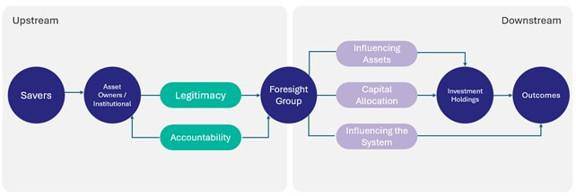
Figure 1. The Stewardship Engine’s foundations are based on legitimacy, accountability, influencing companies, capital allocation and influencing the system9
3. Cross‑group expertise and a unified stewardship model
Foresight’s Real Assets and Private Equity teams already apply strong stewardship and governance practices. This strengthens our systemic engagement, particularly on climate and biodiversity, where scale and coordination matter.
4. Practical enhancements to systems, tools and influence
Across 2025, we strengthened the foundations needed for effective stewardship. These improvements ensure our stewardship model is more scalable, consistent and evidence‑driven across FCM:
- Agreed an ambitious voting policy, with clearer rationales and escalation routes and based on the Association of Member Nominated Trustees (AMNTs) ‘Red Lines’.10
- Began work to streamline engagement monitoring and recording in a single unified, bespoke system.
- Piloted AI supported prioritisation and assessments tools to improve efficiency and consistency in objective‑setting and progress tracking.
- Continued our participation in investor coalitions (IIGCC NZEI, ChemSec IIHC, Climate Action 100 and Nature Action 100), amplifying influence on systemic issues.
5. Early signals of impact: policy influence in action
Our structured approach, now underpinned by Foresight’s Sustainability Accountability Framework11, has already supported a coordinated Group effort to shape policy on Renewable Obligation Certificates (ROCs):
- When proposed changes to ROC indexation risked undermining renewable asset valuations, we applied a disciplined process: assessing material risks, engaging directly with decision-makers across our portfolio companies, and coordinating with industry bodies.
- Foresight submitted a formal response to Government and worked closely with UKSIF, while maintaining active dialogue with affected companies.
- Although the final policy outcome is still pending, this work shows how WHEB’s stewardship model, reinforced by the Group’s accountability framework, positions Foresight as a constructive voice in shaping policy while safeguarding investor interests and supporting the energy transition.
Looking ahead: stewardship built for systemic challenges
The same forces that defined 2025, greater accountability, a more pragmatic view of fiduciary duty, and a shift toward system‑level influence, will continue to shape effective stewardship as we continue through 2026.
FCM is well‑placed to respond. We are strengthening our capability, discipline and reach through the integration of WHEB and Foresight, allowing us to focus on where we are best able to influence for long-term client value.
Building on the foundations set in 2025, and in close partnership with clients and collaborators, our focus is on delivering stewardship that is robust, consistent and fit for addressing the systemic challenges that lie ahead.
1 https://www.ft.com/content/e8ec2bf4-18e6-49a8-925b-82fb5214b4d8
2 https://www.netzeroinvestor.net/news-and-views/the-peoples-pension-moves-28bn-out-of-state-street-citing-stewardship-misalignment
3 https://www.netzeroassetmanagers.org/nzam-ready-for-its-next-chapter/
4 https://media.frc.org.uk/documents/UK_Stewardship_Code_2026.pdf
5 https://sciencebasedtargets.org/news/sbti-launches-draft-corporate-net-zero-standard-v2-for-consultation
6 The Mansion House Accord: signatories pledge to invest 10% of workplace DC portfolios in “assets that boost the economy such as infrastructure, property and private equity” by 2030 (with at least 5% ringfenced for the UK) https://www.gov.uk/government/news/pension-schemes-back-british-growth . A review of the 17 signatories to the UK Government’s Mansion House Accord https://www.pensionsuk.org.uk/Policy-and-Research/Document-library/Mansion-House-Accord shows that the large majority are also signatories to the UK Stewardship Code, reflecting the close overlap between institutions committing to increased investment in private markets and those subject to formal stewardship expectations. Most major pension providers and investment managers involved (including Aviva, Legal & General, M&G, Royal London, Nest, USS and Mercer) have been Stewardship Code signatories since 2021–23, indicating that the expansion of capital into private assets is likely to be accompanied by an extension of established stewardship practices beyond listed equities.
7 https://www.pensionsuk.org.uk/Policy-and-Research/Document-library/Mansion-House-Accord
8 https://www.foresight.group/media/htglji4t/20241030-wheb-stewardship-white-paper.pdf
9 https://www.foresight.group/media/htglji4t/20241030-wheb-stewardship-white-paper.pdf
10 https://www.amnt.org/red-line-voting
11 Foresight's newly implemented Sustainability Accountability Framework defines roles, escalation pathways, and aligns divisional advocacy practices with Foresight Group’s objectives.

